

Here's a question worth asking before any policy gets written: is anyone in your organization using AI right now?
If your honest answer is "I'm not sure," you already have your governance problem. Somewhere, someone is pasting a client note into a chatbot to clean up the wording, or summarizing a report with a free tool they found last month. Not because they're reckless — because the work is heavy and the tool is right there.
That's the real starting point for AI governance. Not "should we allow AI?" — that decision is being made daily, one workaround at a time — but "how do we make those decisions visible, consistent, and defensible?"
This is a practical framework for doing exactly that, sized for health and community organizations that don't have a compliance department to throw at the problem.
What AI Governance Actually Is
AI governance is the set of roles, policies, and processes your organization uses to decide how AI is chosen, deployed, monitored, and retired.
Notice what that definition is not. It's not a binder. It's not a one-time policy document that gets approved at a board meeting and never opened again. And it's not a compliance checkbox that exists to protect the organization from its own staff.
Good governance is an operating process with one goal: consistent, defensible decisions. A fast path to yes for low-risk uses. Real scrutiny for high-risk ones. And a clear answer, every time, to the question "who decided this, and on what basis?"
The test of a governance framework isn't how thorough it looks. It's whether a staff member with a good idea knows exactly where to take it — and gets an answer in days, not quarters.
Why Blanket Bans Backfire
The most common governance mistake we see isn't recklessness. It's the opposite: an organization gets nervous, bans AI outright, and considers the problem handled.
It isn't. The pressure that drove people to the tools — documentation burden, reporting load, too few hours — doesn't go anywhere. So the use continues, invisibly, on personal phones and free accounts, with no oversight, no data protection, and no way to learn from what's happening.
A ban doesn't stop AI use. It just stops you from governing it. The organizations in the strongest position aren't the ones with the strictest rules — they're the ones that know where AI is being used and have decided, deliberately, that each use is acceptable or not.
The Six Parts of a Practical Framework
You don't need an enterprise governance program. You need six questions answered and written down. Here's the framework we'd suggest, whatever your size.
1. Accountability and Ownership
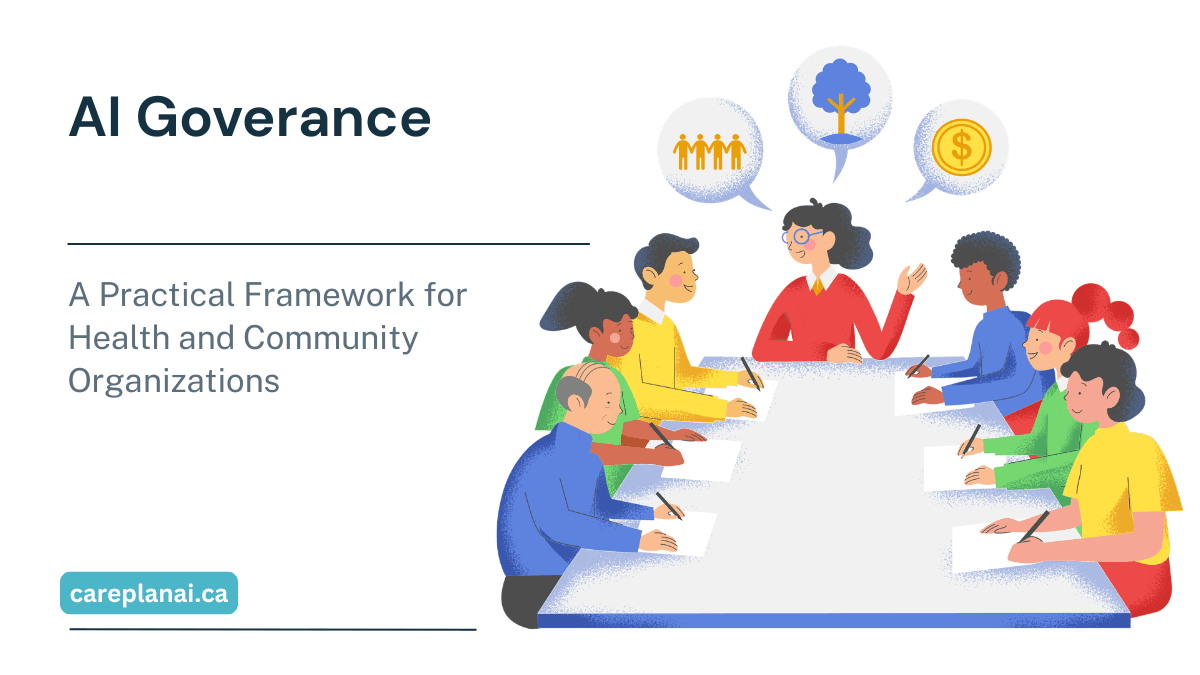
Someone has to own AI decisions — by name, not by committee. In a small organization that might be the executive director plus one operational lead; in a larger one, a small cross-functional group with front-line representation. What matters is that everyone knows who can say yes, who can say no, and who answers for the outcome. Governance without a named owner is a document, not a process.
2. Risk Assessment and Use-Case Triage
Not every use of AI deserves the same scrutiny, and pretending otherwise is how governance becomes a bottleneck. Triage each proposed use by what's at stake: a tool that drafts internal meeting notes is not in the same category as one that touches client records, and neither is in the same category as anything that influences decisions about a person's care or eligibility. Low-risk uses get a fast yes with basic conditions. High-risk uses get real review. The tiers do the work.
3. Vendor and System Evaluation
Most organizations won't build AI; they'll buy it. That makes vendor due diligence a core governance activity: where does the data go, is it used for training, where does it reside, what happens when the contract ends, and what does the vendor actually commit to in writing? Ontario's Information and Privacy Commissioner, in its guidance on AI tools in the health sector, puts vendor assessment and contractual safeguards at the centre of responsible adoption — because a promise that isn't in the contract isn't a safeguard.
4. Data Protection and Privacy
For health and community organizations in Canada, this is non-negotiable territory: PHIPA in Ontario, PIPEDA federally, and their provincial counterparts govern how personal and health information is collected, used, and disclosed — and an AI tool doesn't get an exemption because it's new. The practical questions are concrete. Can this tool see only what the role using it is permitted to see? Is consent handled properly? Is there an audit trail? If a tool can't answer those, the governance answer is no, however impressive the demo.
5. Human Oversight and Scoping
We've made this argument before in the context of change management, and it belongs in governance too: scope the tool narrowly, and keep judgment with people. The AI drafts; the human decides. A tool with a defined job — draft the note, assemble the report, capture the update — is easier to evaluate, easier to trust, and easier to oversee than a tool with vague, expanding authority. Every approved use case should state, in writing, what the tool does and where the human stays in the loop.
6. Monitoring and Lifecycle Management
Approval is the beginning of governance, not the end. Tools change under you — models get updated, vendors get acquired, terms of service shift — and your uses change too. Review each approved use on a schedule, know what you'll do when something goes wrong, and be willing to retire a tool that no longer earns its place. An AI system you approved two years ago and haven't looked at since isn't governed. It's just old.
Start With One Page and a Register
If the six parts above sound like a year-long project, here's the honest version: you can start this month with two artifacts.
A one-page policy. Who owns AI decisions, what's always out of bounds (client data in unapproved tools, for a start), how to propose a new use, and how fast you'll answer. One page that people actually read beats forty pages that nobody does.
A use-case register. A living list of every place AI is used in your organization — each entry with its risk tier, its owner, and its status. This is the single most useful governance artifact you can create, because it converts AI use from something invisible and ad hoc into something you can see, triage, and review on a schedule. It's also the honest starting point: the first version of the register should include the uses already happening, not just the ones you've blessed.
Everything else — the vendor checklist, the review cadence, the incident process — grows out of those two documents as your use of AI grows. Governance should be sized to what it governs.
The Standard Your Framework Will Be Measured Against
You don't have to invent the principles yourself. In January 2026, Ontario's Information and Privacy Commissioner and the Ontario Human Rights Commission jointly published principles for the responsible use of AI: AI systems should be valid and reliable, safe, privacy protective, human-rights affirming, transparent, and accountable.
The principles are aimed at public sector organizations, but the regulators have been clear that they'll ground how privacy and human-rights obligations are assessed as AI adoption spreads. For any organization delivering care or services in Ontario, they're the closest thing to a published answer key — and the six-part framework above is, in practice, how a smaller organization operationalizes them.
The pattern across all of this guidance is consistent: know what you're using, know who's accountable, protect the data, keep humans in the loop, and keep watching after go-live. None of it requires an enterprise budget. All of it requires deciding to look.
Conclusion: Governance Is How You Get to Yes
It's tempting to see governance as the department of no — the process that slows everything down while the burden that made AI attractive keeps piling up.
Done well, it's the opposite. A good framework is how an organization says yes quickly and safely: low-risk uses clear in days, high-risk uses get the scrutiny they genuinely need, and staff stop making these calls alone in the dark. The alternative isn't a slower version of the same adoption. It's ungoverned adoption — the kind you find out about after something goes wrong.
We've written before that buying AI is easy and making it useful is the harder part, and that adoption is won through change management, not procurement. Governance is the third leg of that stool: it's what makes the first two repeatable, so the second AI decision is easier than the first, and the tenth is easier still.
If you're building your framework and want a platform that makes governance easier rather than harder — role-based access, audit logging, and privacy by design as standard — see how CarePlan AI works, or book a conversation and we'll talk through what right-sized AI governance looks like in your organization.