

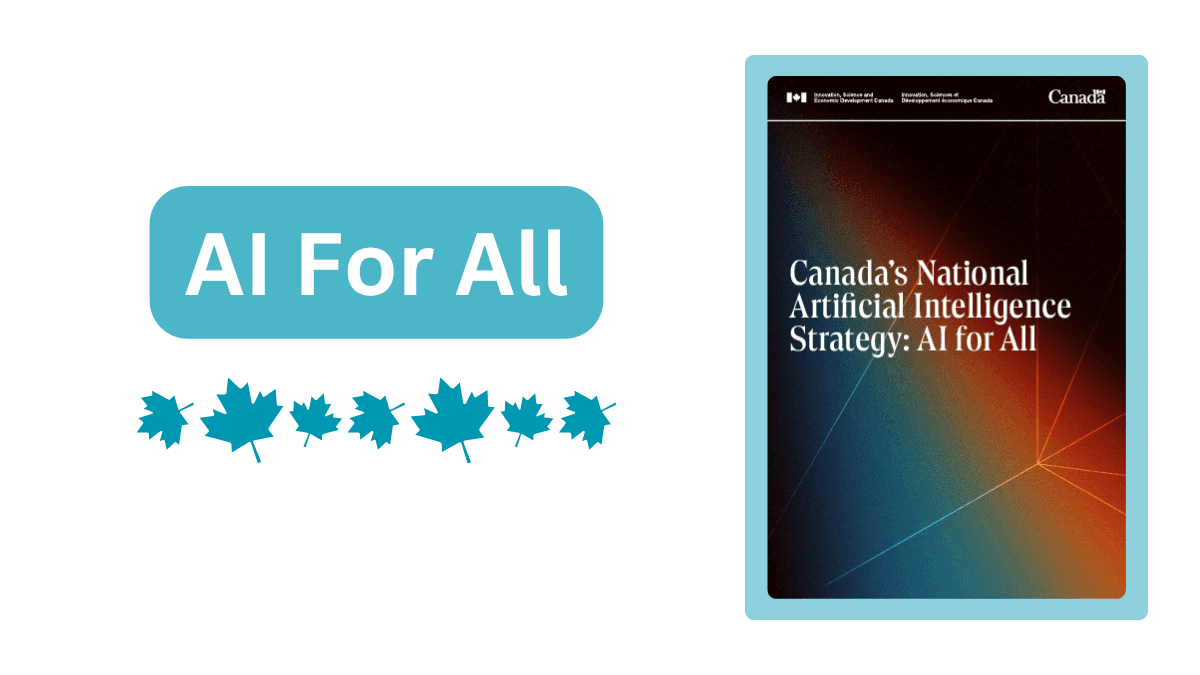
On June 4, 2026, Prime Minister Mark Carney stood in Toronto and launched AI for All, Canada's new national artificial intelligence strategy. The name is a promise. The question worth asking, from where we sit, is who "all" actually includes.
The strategy's headline ambitions are big: an additional $200 billion in economic growth, 250,000 new AI-related jobs over five years, and a leap in AI adoption from just over 12% today to 60% by 2034. Its first flagship initiative is a health mission. And its first funded health project is a hospital data platform.
That last detail is the one community and home care organizations should read closely. Because the gap between Canada's 12% adoption rate and its 60% target will not be closed inside hospitals alone. It will be closed, or missed, in the parts of the system that rarely make the press release: home care, community supports, disability and social services, and the Ontario Health Teams trying to stitch them together.
This is a strategy our sector should welcome. It's also one we have to read carefully, so that "for all" includes the people we serve.
What AI for All actually says
The strategy is built on three guiding principles, drawn from national consultations that gathered more than 11,000 submissions and the work of a 28-member expert task force. It's worth understanding each on its own terms before asking what it means for community care.
Building trust
Ottawa is framing trust as the precondition for adoption, not an afterthought to it. The trust pillar promises to modernize legislation for the digital age, stronger protections for personal information, new rules against harms like deepfakes and surveillance pricing, an online safety regime, and improved AI transparency, alongside an expanded Canadian AI Safety Institute to evaluate AI models.
The logic is one we've argued for a long time: people will only use tools they trust, and in health and human services, trust is not a marketing word. It's consent, safety, and accountability made concrete.
Creating opportunity
The opportunity pillar is about diffusion, getting AI into the hands of ordinary Canadians and ordinary organizations. It includes a National AI Literacy Initiative reaching a million post-secondary students and training more than 3,000 educators, trusted AI agents for every post-secondary student, up to 90,000 AI-related jobs and placements for young Canadians, and direct support to help small and medium-sized businesses adopt AI.
It also includes the first AI Missions Program, with a flagship health mission to accelerate AI in diagnostics, patient care, and system efficiency.
Reinforcing sovereignty
The third pillar is about control: building sovereign Canadian compute, cloud, connectivity, data, and talent so that Canadian institutions can build and adopt AI on Canadian terms. A public AI supercomputer, growth capital for Canadian champions, government procurement used as a strategic anchor customer, and investment in the talent pipeline.
For anyone who handles Canadian health information, the word "sovereignty" should land with particular weight. Where data lives, who controls it, and under whose laws it's governed are not abstract questions in our sector.
The health mission is real, and it starts in the hospital
The most concrete health commitment in the strategy is money. The AI Missions Program is backed by roughly $200 million, and up to $100 million of that is earmarked for a Health Sector Data Space, expanding an Ontario-born platform called VITAL, run out of Toronto's St. Michael's Hospital, that pools anonymized hospital records for research and is set to scale from 160 hospitals across Alberta, Ontario, and Quebec toward full national coverage (Unity Health Toronto).
This is a genuinely good thing. Better, more connected hospital data improves diagnostics, research, and system planning, and it does so with anonymization and governance built in.
But notice where it lives. The flagship is hospital-centred, diagnostics, acute care, life sciences. That's where the data infrastructure already exists and where the investment case is easiest to make.
It is not where most care happens.
The majority of a person's interactions with the health and social system happen outside the hospital: in home visits, community programs, intake interviews, support coordination, and the slow, relational work of helping someone live well. That work generates enormous amounts of information, and almost none of it sits in a tidy hospital record waiting to be pooled.
Why "for all" has to include the work outside the hospital
There's a structural reason this matters right now, beyond fairness.
Canada is deliberately shifting care toward the community. Ontario's 2026 budget committed roughly $1.1 billion in additional home care funding over three years, explicitly to help more people receive support at home rather than in hospital or long-term care. Aging in place is becoming the policy default across the country.
So the system is moving care out of the hospital at the same moment its flagship AI investment is moving deeper into it. If the national adoption target is to rise from 12% to 60%, the math only works if the community sector, historically under-resourced, under-digitized, and overlooked by enterprise software, can adopt AI too.
That sector faces a different reality than a research hospital:
- The data isn't standardized. A community wellness program, a home care provider, and a developmental services agency track fundamentally different things, in different ways, for different funders. There is no single national schema waiting to receive them.
- The budgets are smaller. These organizations can't fund custom integrations or data-science teams. Adoption has to be affordable and immediate, or it doesn't happen.
- The consent stakes are personal. Community records hold some of the most sensitive information about a person's life, housing, family, disability, mental health. Pooling it is not as simple as anonymizing a lab result.
"AI for all" is the right ambition. But all means the home care coordinator and the intake worker, not only the radiologist.
Trust, sovereignty, and consent: where the strategy and our sector already agree
The encouraging part is that the strategy's principles map almost exactly onto the realities of community care, if they're applied there.
Trust is consent made operational
The strategy treats trust as foundational, and so does our sector, by law. In Canada, how personal health and personal information is protected and shared is governed by frameworks like Ontario's Personal Health Information Protection Act (PHIPA) and the federal Personal Information Protection and Electronic Documents Act (PIPEDA). These laws govern how information is handled and consented to, not merely where it's stored.
That's the same instinct behind Ontario's recent privacy guidance asking health organizations to assess AI vendors, set contractual safeguards, monitor systems over time, and keep clear accountability when AI touches personal health information (Information and Privacy Commissioner of Ontario). A national strategy that elevates trust is, in effect, asking every organization to be able to answer those questions. For community providers, that means AI that operates only on the data a role is permitted to see, the principle of least privilege, applied to AI as much as to people.
Sovereignty is more than where the servers are
The strategy's sovereignty pillar is about Canadian control of compute, data, and talent. For care organizations, sovereignty has always had a sharper edge: it's about Indigenous data governance, provincial residency requirements, and the simple expectation that Canadian health data is governed under Canadian law. We've written before about the long arc from on-prem to cloud in Canada and what it taught us about trust and risk, and about OCAP principles and Indigenous data sovereignty, which a national data space will have to respect, not override.
Sovereignty done well is an enabler for our sector. Sovereignty treated as a slogan is a risk.
The honest caveats
It would be a disservice to read the strategy uncritically, so two things are worth naming.
First, much of AI for All is a framework, not yet a program. The legislation is promised, not passed. Several commitments are directional, and commentators have noted the strategy is lighter on concrete safety mechanisms than on economic targets. The detail that determines whether this helps community care will come in the implementation, the eligibility rules, the funding criteria, the standards.
Second, adoption targets are not adoption. Moving from 12% to 60% is an enormous behavioural shift, and the survey data released around the launch suggests many Canadians remain wary of AI in their lives. A target on a slide doesn't change that. Trust is earned in the specific, in whether the tool a frontline worker actually touches is safe, useful, and respectful of the person on the other side of the table.
That's not a reason for cynicism. It's a reason to engage early, while the rules are still being written.
What community and home care organizations can do now
You don't have to wait for the legislation to get ready. The organizations that benefit most from AI for All will be the ones already positioned to adopt responsibly when the programs arrive.
- Get your data into shape, on your terms. AI is only as useful as the structured information underneath it. Capturing your work in well-designed, typed fields, rather than free-text notes, is what makes future tools, funding, and reporting possible.
- Make consent and access a system feature, not a policy binder. Be able to show who can see what, and why. That's the trust pillar, made real at your scale.
- Treat sovereignty as a procurement question. Ask vendors where data resides, under whose law it's governed, and how Indigenous and provincial requirements are met.
- Focus on fit, not hype. As we've said before, buying AI is easy; making it useful is the harder part. The right question isn't "do we have AI?" but "does it fit the work our team actually does?"
Conclusion: Make sure "all" includes you
AI for All is the most ambitious statement Canada has made about its technological future, and the emphasis on trust, opportunity, and sovereignty is the right one. For a sector that has spent years being treated as an afterthought to acute care, a national strategy that names health first is genuinely good news.
But strategies set direction; they don't guarantee inclusion. The flagship investment starts in the hospital, and the hardest, most human parts of the system, the home visit, the community program, the support plan that has to follow a person across settings, will only be part of "all" if the sector insists on it and prepares for it.
The real risk, as ever, isn't moving too fast. It's standing still while the infrastructure, the funding, and the standards get defined around us. The organizations that engage now, getting their data structured, their consent operational, and their sovereignty questions answered, are the ones who will be ready when "AI for all" finally reaches the work that happens outside the hospital walls.
Wondering what responsible AI adoption looks like for your programs? You can build it as a living, structured system in CarePlan AI, or simply talk to our team about where AI actually fits in your work.