

From Lists to Intelligence
Ontario Health Teams are increasingly expected to support Ontario Health and the Ministry with clear, data-driven insights. They are asked to show not just who their partners and providers are, but how engaged they are, where they are on their digital journey, and how this all connects to access, attachment, and wider system performance.
Spreadsheets, simple databases, and traditional CRMs can each handle pieces of that puzzle. They are good at storing lists, tracking contacts, or logging activities. What they do not easily provide is a connected, evolving view of the whole primary care ecosystem, one that can support both today's reporting needs and tomorrow's more advanced workflows, like patient-provider matching and targeted outreach.
At Middlesex London OHT (MLOHT), CarePlan AI is being used to fill that gap. Rather than acting as a typical CRM, it functions as the central tracking and reporting database (or "intelligence engine") for OHT functions. While this process is ongoing and iterative, significant steps have been made to ready the organization for what will certainly be a fast and demanding future.
What CarePlan AI Is Doing for MLOHT Today
Partner and Provider Tracking
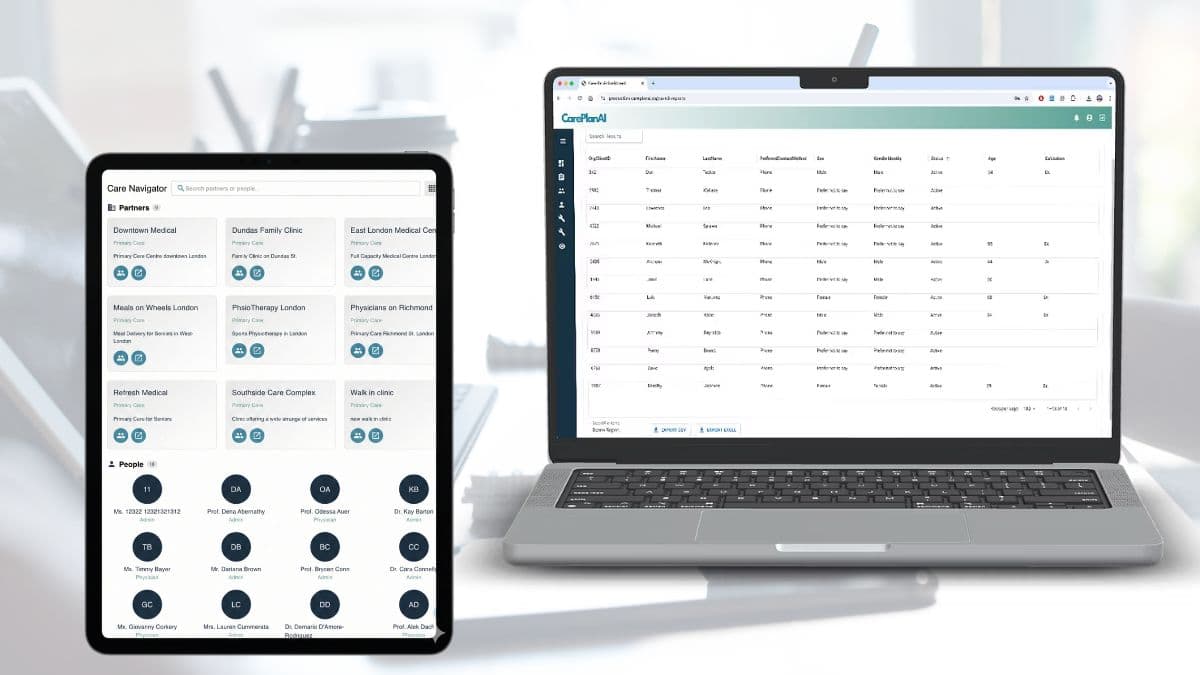
CarePlan AI maintains a comprehensive record of all primary care offices and clinics, and can, when the OHT is ready, include all OHT partners in the regional along with the people and structures around them. The system tracks:
- Practices and clinics
- Physicians, nurse practitioners, and other key contacts
- Patients before paperwork priorities
- Family Health Organizations, Family Health Teams, Primary Care Networks, and OHT memberships, to name a few.
These records are fully relational, so the OHT can see how practices, providers, and memberships connect to each other. Instead of separate lists that easily fall out of sync, MLOHT has a single "big picture" view of the landscape: which practices belong to which group, who works where, and how that aligns with broader OHT initiatives.
The system also tracks OHT membership and engagement:
- Who is a member of the OHT and PCN, whether they are active or inactive and, their level of engagement.
- What level of engagement each practice has with different initiatives.
- Which practices have adopted specific tools such as eConsult, eReferral and OAB.
This is not just a static snapshot. CarePlan AI captures the progression of data over time. For example, a practice might start with no digital tools, then adopt eConsult, then eReferral, and eventually Online Appointment Booking (OAB). This allows MLOHT to see the digital adoption journey of each practice rather than a single "yes/no" status. This prepares them for an environment where Ontario Health begins to expect more detailed real-time reporting in an increasingly digital age.
Standardized Reporting and Interim Intelligence
Because the data is structured and standardized, CarePlan AI supports interim and routine reporting without rebuilding logic every time. MLOHT can answer questions such as:
- How many practices are actively working on chronic disease management?
- How many practices have OAB, and how has that changed over time?
- Who in primary care has capacity to take on new patients in our region?
- What is our next priority?
Instead of pulling together multiple spreadsheets and manually patching insights, the OHT team can rely on a single data set and shared templates. This reduces the effort required to prepare reports for Ontario Health and the Ministry of Health and improves consistency from one reporting cycle to the next.
How It Changes Day-to-Day Work
For the OHT team, the system is designed so that authorized members have real-time access to the information they need. With appropriate permissions in place, staff can:
- Enter data efficiently as they work.
- Pull reports directly from the system.
- View maps displaying practice locations and key attributes.
- Analyze trends in membership, digital adoption, and engagement without waiting for someone else to update or circulate a file.
This reduces redundancy and the amount of logic that lives "inside people's heads." It lowers the risk of conflicting versions, outdated data, or uncertainty about which list is the "real" one; issues that often surface during staff transitions or audits. These risks are inherent and persistent with isolated sheets and manual processes.
Importantly, CarePlan AI does not have to replace Excel files or other tools entirely. Teams can continue to use spreadsheets where they make sense, while using CarePlan AI as the common source of truth and collaboration layer. Data that needs to be shared, trusted, and reported on lives in one place; individual analyses and one-off work can still happen in familiar tools.
Want to learn how CarePlan AI can support your Ontario Health Team? Visit our OHTs page or reach out to us to start the conversation.