

Somewhere in most community care organizations there is a spreadsheet. It lists who has done their required training, when, and when they need to do it again. It is almost always out of date, it is usually maintained by one person, and no one fully trusts it — least of all when an auditor, a funder, or an accreditation surveyor asks to see it.
That spreadsheet is the thing a healthcare LMS is supposed to replace. Most of them don't, quite. They replace the delivery of training — they play videos and score quizzes — while the part that actually keeps you compliant stays exactly where it was: in a separate tool, disconnected from the staff, sites, and clients it's meant to protect.
This is a field guide to a different approach: a learning management system built into the care platform itself, designed compliance-first. It's the LMS inside CarePlan AI, and this is everything it actually does — written plainly, so you can judge it on the specifics rather than the adjectives.
What a Healthcare LMS Is Really For — and Where Most Fall Short
A healthcare LMS (learning management system) is software for authoring training, assigning it to staff, and tracking who has completed what. In care settings, the tracking half is the point. You aren't running a university; you're proving that the people delivering care have the training the work — and your regulators and funders — require.
That's where generic tools fall short. A course player treats "compliance" as a report you assemble after the fact. It can tell you who clicked "complete." It usually can't tell you who is actually compliant right now, why someone isn't, or what happens automatically when a certification lapses next month.
The difference isn't a longer feature list. It's a starting assumption: that the system exists to keep an honest, current picture of readiness across your whole organization — not to deliver slideshows.
One System, Not an Integration
CarePlan AI includes a full learning-management and training-compliance system built into the same multi-tenant platform that already holds your clients, care entities, and care plans. It is not a separate LMS bolted on beside them.
That matters for a practical reason. When training lives in the same place as everything else, "show me overdue training by site" becomes a question you can just ask — because the training data sits next to the org chart, the sites, and the reporting you already use. There's nothing to sync and no second login.
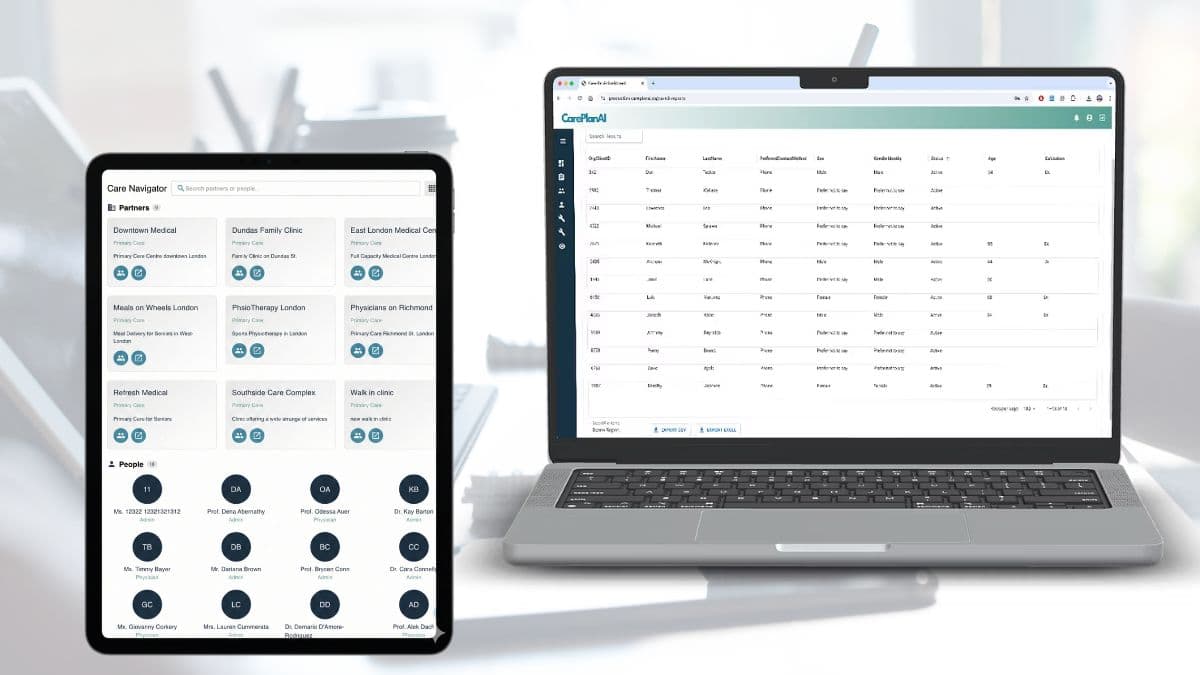
The system presents itself as three purpose-built surfaces, each for a different job:
- Course Management — the catalogue for training leads: search and filter courses, see per-course average engaged time from real completions, and create, edit, archive, or preview a course.
- Trainee Management — the compliance roster for managers: one row per staff member, classified compliant, not compliant, or no training, with the specific issue named and a drawer of per-course actions.
- My Training — the learner's view: cards grouped by state with one clear next action — Start, Resume, Retake, or Review — plus due dates, score rings, and time engaged.
A fourth, read-only Training tab sits on each user's profile for administrators who need to look without touching, and deep-links into Trainee Management to act.
Permissions That Match Real Roles
Each surface is its own independently grantable permission, with separate view, add, edit, and delete rights. A scheduler can be given the compliance roster without the ability to author courses. An author can be kept out of staff records entirely. And a manager's reach can be scoped to their own care entities, so they see and act on their own sites — not the whole organization.
This is the principle of least privilege applied to training: people get exactly the access their job needs, and nothing more.
Author Your Own Courses
Courses are built inside CarePlan AI through a four-step flow — Create → Design → Define → Assign — where a course is a set of chapters, each holding an ordered list of content blocks. There are eight block types, so a course can do more than play media:
- Video (uploaded, YouTube, or Vimeo), Audio, PDF or document (rendered inline, never force-downloaded), and presentations viewed in place.
- Text blocks with rich formatting, acknowledgements the learner must tick before advancing, and quiz questions — one block can hold several, single- or multi-answer.
- Structure and form fields — page breaks, headers, and the platform's standard fields — so a course can capture a value, not just deliver content.
Authoring has real safety nets, because losing an afternoon's work to a closed tab is its own kind of compliance risk. The builder autosaves every 30 seconds with local draft recovery. Editing a live course stashes the changes as a draft, so learners keep seeing the published version until you explicitly publish — and the catalogue flags that a draft exists so the two states can't be confused. Every publish snapshots the previous content into a change log and bumps the version, and before you republish, the system tells you how many learners are mid-course so you can decide whether to move them onto the new material.
It also refuses to publish something incoherent — a passing score with no quiz questions, or a renewal interval with no valid day count — with an actionable message rather than a silent failure.
Completion You Can Defend in an Audit
Here is the part that separates a compliance system from a course player: in CarePlan AI, a completion record is evidence, not a self-report. There is no "I watched it" button.
- Video is measured, not declared. A video counts as watched only when playback actually reaches the near-end threshold — 95% played, or within the last three seconds — and the rule is enforced identically for uploaded files, YouTube, and Vimeo.
- Documents and presentations have a review gate. The Next button stays locked for a minimum viewing period — 15 seconds by default, configurable per block — with a visible countdown.
- The honest clock wins. The player tracks both wall-clock time and engaged time, and engaged time only accrues while the browser tab is actually visible. The server stores both and clamps engaged time so it can never exceed wall-clock time. Reporting uses engaged time.
- Quizzes are graded on the server, with point-weighted questions, a configurable passing score, and attempt limits. When attempts run out, the learner gets a locked review that deliberately does not reveal the correct answers — because a manager may still choose to grant another attempt.
- Learners resume exactly where they stopped — page position, entered answers, and accumulated engaged time are all saved continuously, so a returning learner never re-sits a video they already finished.
None of this is about distrusting staff. It's about being able to stand behind the record when someone asks you to.
Compliance That Maintains Itself
The most valuable thing the system does happens when no one is looking. Every assignment moves through a defined lifecycle — not_started, in progress, completed, expired, overdue, failed, or waived — and the platform, not an administrator, is what moves it between states. An overdue course is still completable; a failed one returns to in-progress on retake while attempts remain. A waiver is the one exit a human makes deliberately. Everything else happens on its own.
Training That Knows Your Org Chart
Assignments get created three ways. A course attached to a role auto-assigns to everyone in it — and to anyone later hired into or moved into that role, with no administrative step, so a new hire's mandatory training is waiting on day one. Courses can also be assigned to named people at publish, or in bulk to any set of staff, with the operation re-validated against the caller's organization and site scope and safely skipping anyone already covered.
Renewals on the Calendar Regulators Actually Use
Training expires, and CarePlan AI models that the way real requirements work. There are five cadences — none, annually, every six months, quarterly, or a custom day count — in two modes: rolling (due a set number of days after the last completion) and fixed calendar (the same date every cycle, such as every January 15, which is what regulatory calendars look like). A configurable grace period keeps a certification from lapsing the instant the clock ticks over.
A single nightly job — running at a fixed local hour, in batches, holding a lock so it runs once even across multiple servers — marks assignments overdue, expires completed ones whose time is up, generates the next renewal anchored to when the last one expired so cycles don't drift, and notifies anyone whose certification expires within 30 days. Once, not daily.
Compliance itself is judged on each learner's current cycle only, so renewal history never counts against someone twice. And the roster and the summary tiles above it share one classification engine, so the headline number and the rows beneath it can never disagree.
The Exceptions, Handled
Real compliance work is mostly exceptions, and managers handle them from one place — the trainee drawer — course by course, person by person: waive a requirement, grant an extra quiz attempt, record a manual completion (with a reason, kept on the record as manager-entered), extend a due date, send a status-aware reminder, send one digest covering everything a person has outstanding, or unassign entirely.
Not all care training is self-paced, either. A course can be flagged for in-person group delivery: an authorized host runs it in the room, adds attendees who are already assigned and within the host's site scope, and on completion the system writes a real completion record for every attendee, with expiry calculated from that course's renewal rules.
AI and Privacy, Handled Responsibly
Training records are a first-class citizen of the platform's AI features, not a walled garden — but the design is deliberately conservative.
You can ask for a training report in plain language ("who's overdue by site?") and get a saveable, re-runnable answer, because the AI reads the same real fields the reports use. A weekly compliance rollup agent can aggregate each organization's gaps and draft a manager escalation — but its remit is deliberately narrow: read and notify only, zero writes to training records, behind a per-organization switch that is off by default, and every draft lands in an inbox for a human to review before it sends. This is responsible AI by design: the tool surfaces and suggests; a person stays accountable.
On privacy, every training record is scoped to an organization, and queries enforce that scope even for administrators — an admin in another organization gets no bypass. Managers without org-wide visibility see only their own sites, and out-of-scope records are dropped server-side rather than quietly leaking. This is the accountability posture that laws like Ontario's Personal Health Information Protection Act (PHIPA) expect: PHIPA and its federal counterpart, PIPEDA, govern how personal information is protected and who is accountable for it, and a system that enforces scope by default makes those obligations answerable instead of aspirational.
What It Deliberately Is Not
Being trustworthy also means being clear about the edges. The CarePlan AI LMS does not import SCORM, xAPI, or third-party course packages — courses are authored in the platform. It does not generate certificates, badges, or printable transcripts, ship a ready-made course library, or host live video for group sessions (it records in-person attendance; it doesn't run the call). And it doesn't claim to be pre-certified for any particular standard — it records and enforces the rules you configure. If a vendor promises all of that in one box, it's worth asking what "compliant" really means in their demo.
Conclusion: The Real Risk Is the Spreadsheet
It's tempting to treat training compliance as a back-office chore — something a spreadsheet and a diligent coordinator can hold together. But the status quo has a running cost. A certification lapses and no one notices until an incident. A new hire starts care work before their mandatory training is assigned. An auditor asks for evidence and you spend a week reconstructing it from memory and email.
In community care, those aren't administrative problems. They're safety problems, and they land on the same stretched team every time. The honest question isn't whether a new system is worth the change. It's what the current one is quietly costing you.
A healthcare LMS built into your care platform doesn't just move the spreadsheet online. It makes the spreadsheet unnecessary — because the system itself keeps the picture current, proves completion honestly, and renews on the calendar your regulators actually use.
If your compliance picture currently lives in a file only one person understands, that's the place to start. Bring your messiest training requirement — the one with the awkward renewal rule and the site-by-site exceptions — and we'll build it as a living course and compliance workflow in CarePlan AI.
Book a walkthrough and bring your training-compliance spreadsheet. We'll map one real requirement end to end — authoring, assignment, renewal, and the audit trail — so you can see the difference on your own data.